
Multi-stem Trees
Malus toringo var. sargentii
Sargent crab apple
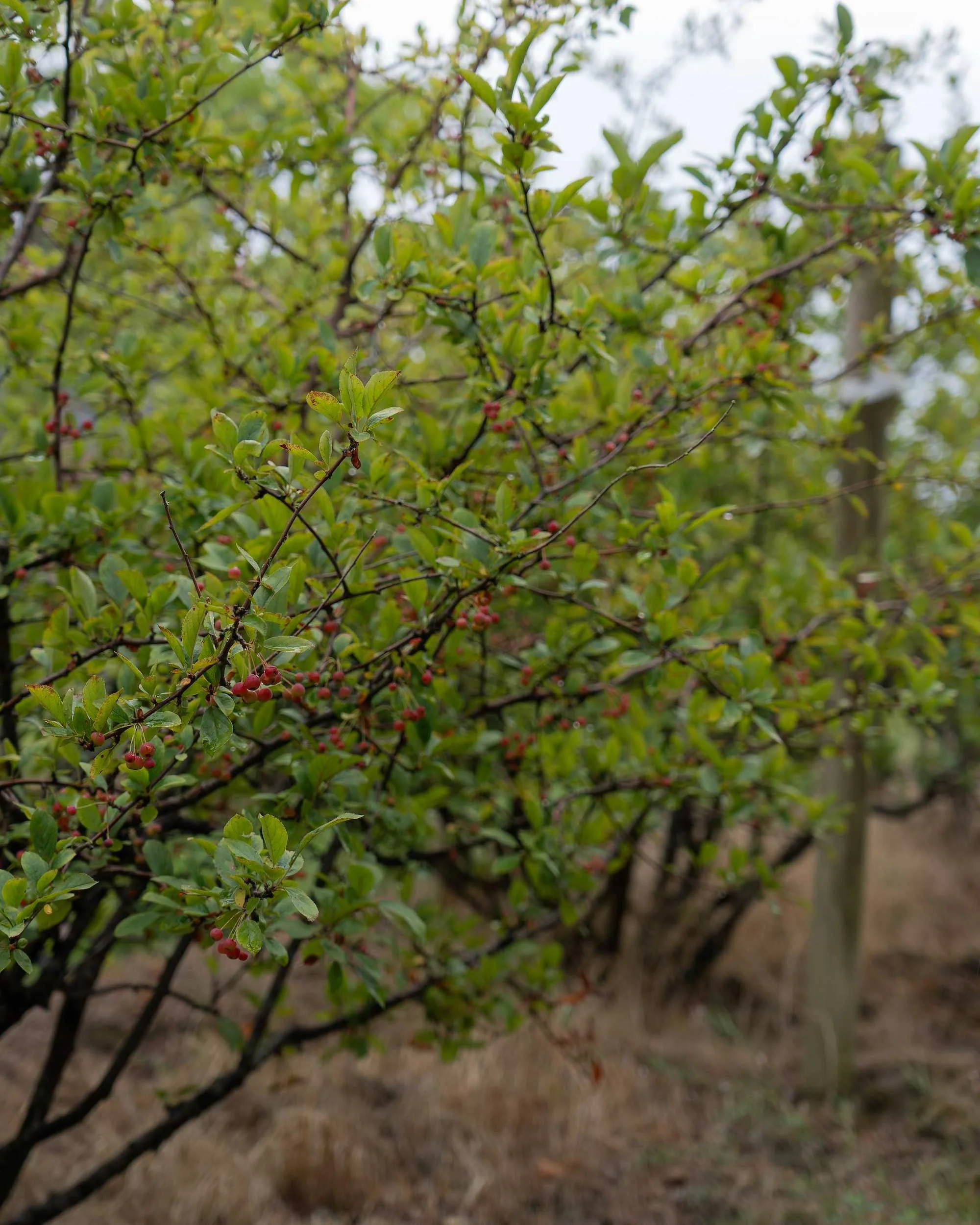
A low, spreading crab apple covered in pure white blossom, followed by small, bright red fruits. Compact and characterful.
Masses of pure white blossom
Small, bright red fruits
Low, spreading habit
Ideal for small gardens
Please check before you visit. Our nursery is very well stocked, but what we hold changes with the seasons, so this plant may not always be in stock. Enquire before you head over and we will check availability and the sizes we have for you.
At a glance
Type
Multi-stem tree
Foliage
Deciduous
Seasons of interest
Spring blossom, autumn fruit
Eventual size
Typically 2 to 3 m tall, wider than tall
Position
Full sun or partial shade
Soil
Most well-drained soils
Hardiness
Fully hardy in the UK
Available
A range of sizes and forms. Ask our team for current specimens and pricing.
Why we love it
Malus toringo subsp. sargentii, the Sargent crab apple, is a charming, small-scale crab that grows wider than it is tall. In late spring its branches are smothered in pure white, lightly fragrant flowers with golden stamens, opening from buds that can be tinged pink. In autumn they are followed by masses of tiny, glossy, dark red fruits, no bigger than a pea, that birds love, and the leaves often turn warm yellow before they fall.
Grown as a multi-stem, it forms a low, spreading, layered shape, almost like a large flowering shrub lifted onto short stems, which gives it a natural, slightly Japanese feel. Native to Japan and named after the American plant collector Charles Sprague Sargent, it is one of the most compact crab apples, making it ideal where a full-size tree would be too much.
Choosing a size
As a multi-stem, the Sargent crab is chosen by spread as much as by height, because its beauty lies in its broad, horizontal branching. A younger plant suits a large container or a small border, while a mature specimen gives you a fully formed, layered canopy straight away. Every plant has its own outline, so choosing by eye is the best way to find the shape that suits your space.
How to use it
Plant it in a small garden, a courtyard or on a bank where its spreading habit can be appreciated, or beside water, where the branches can arch outwards. It is lovely in a Japanese-inspired scheme with mossy stones, ferns and grasses, and makes a superb low focal point in gravel or at the front of a deep border. It also suits a large pot on a terrace.
Planting
Plant root-balled specimens between November and March, and pot-grown plants year-round if watered in dry spells. Dig a hole two to three times the width of the root ball but no deeper, plant at the same level and stake if the plant is top-heavy. Water well and mulch with peat-free compost.
Looking after it
Water deeply through dry spells for the first two summers. Pruning is minimal: in winter, while it is dormant, remove any dead or crossing branches and the occasional upright shoot to keep the characteristic spreading shape. It grows in most well-drained soils, including clay and chalk, and does best where the ground does not stay wet.
Is Malus sargentii a shrub or a tree?
It sits somewhere in between. Naturally it is a dense, spreading, shrub-like crab apple, typically only 2 to 3m tall and wider than tall. Grown as a multi-stem with a few lifted stems, it takes on the character of a small, broad tree, making it perfect for gardens that want blossom and fruit without much height.
See it in person
Every plant at Form is hand-selected, none contains new peat, and nothing beats choosing yours by eye. Visit our Row Town showroom in Surrey, just 30 minutes from London, where our team will show you the best of what is on the nursery right now. We deliver across London, Surrey and the Home Counties, and nationwide.
Walk in any time during opening hours and you will be looked after. If you would like dedicated time with a specialist, book a Genus Bar appointment.

Frequently asked questions
-
It typically reaches 2 to 3m tall and grows wider than it is tall, forming a low, spreading small tree.
-
It flowers in late spring, usually in May, with white, lightly fragrant blossom.
-
The fruits are tiny, glossy and dark red, about the size of a pea, and ripen in autumn.
-
Yes, it is one of the smallest crab apples and ideal for small gardens, courtyards and large containers.
-
Yes, the blossom feeds bees in spring and birds eat the small fruits in autumn and winter.
-
Yes, its compact size suits a large container filled with peat-free, loam-based compost. Water regularly through summer.
-
It grows in full sun or partial shade, flowering and fruiting best with plenty of sun.
-
It is native to Japan and is named after Charles Sprague Sargent, the first director of the Arnold Arboretum in Boston.
-
We keep a very well-stocked nursery, but our stock changes with the seasons, so availability varies. Please email us before you visit and we will check what we have and the sizes available.
-
Yes, and we would love you to. Every multi-stem tree is individual, with its own branch structure and character, so we always encourage customers to choose by eye. Our largest specimens are held at our Row Town showroom in Surrey. Walk in any time during opening hours, or book a Genus Bar appointment with one of our specialists. If you can’t visit, we are happy to send photographs of individual trees.
-
Yes, we deliver nationwide. Deliveries are arranged by our dedicated in-house operations team, and larger specimens can be offloaded by HI-AB or Moffett where needed. We will always agree the most suitable option with you before delivery.
All our multi-stem trees
Explore every tree in our multi-stem trees collection, or view them all with photographs →
Malus toringo var. sargentii
Can’t see what you’re looking for?
Get in touch and we’ll help you find it. Our nursery is very well stocked and we can source almost any plant through our network of trusted growers. Email info@formplants.com, or send us your whole plant list through our bespoke sourcing service.