
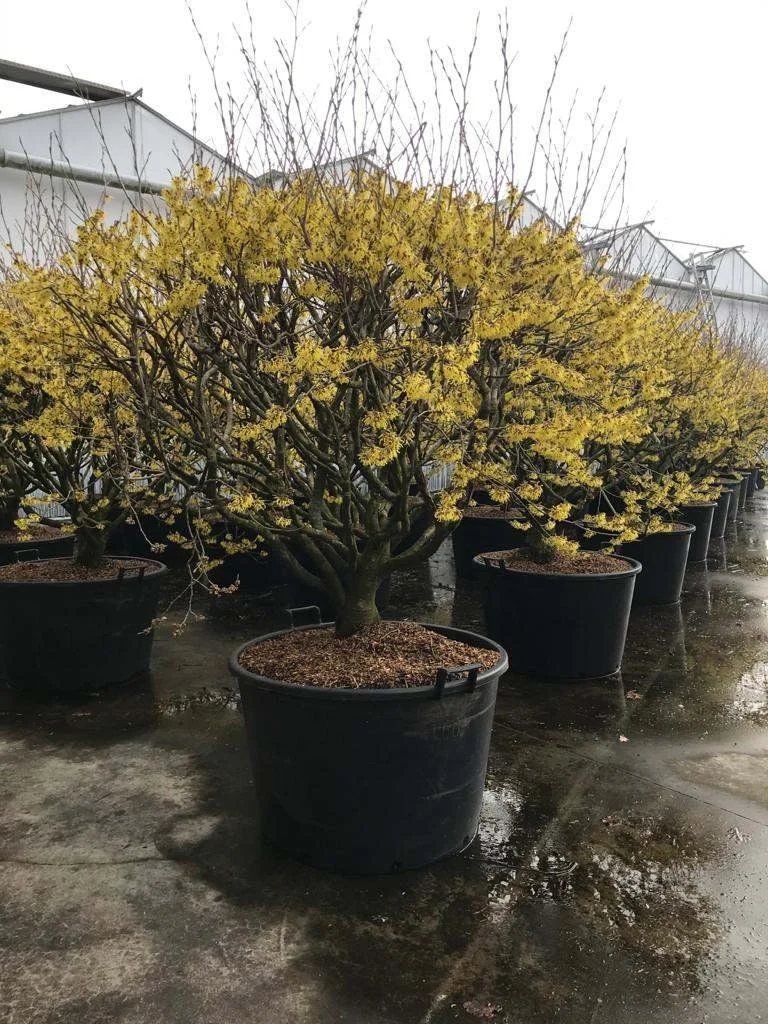
Multi-stem Trees
Hamamelis × intermedia 'Arnold Promise'
Witch hazel
Spidery, sweetly scented yellow flowers on bare stems in the depths of winter, then glowing autumn colour.
Scented yellow winter flowers
Flowers on bare stems in midwinter
Orange and red autumn colour
Compact and ideal for smaller gardens
Please check before you visit. Our nursery is very well stocked, but what we hold changes with the seasons, so this plant may not always be in stock. Enquire before you head over and we will check availability and the sizes we have for you.
At a glance
Type
Multi-stem tree
Foliage
Deciduous
Seasons of interest
Winter flowers, autumn colour
Eventual size
Typically 3 to 4 m tall
Position
Full sun or partial shade
Soil
Moist, well-drained, neutral to acid
Hardiness
Fully hardy in the UK
Available
A range of sizes and forms. Ask our team for current specimens and pricing.
Why we love it
When the garden is at its quietest, Hamamelis × intermedia 'Arnold Promise' lights it up. From late winter, its bare branches are studded with clusters of spidery, ribbon-like flowers in clear butter yellow, and on a mild, still day their sweet, spicy scent drifts across the garden. It is one of the later witch hazels to bloom, which often means it carries on flowering into March, bridging the gap between the snowdrops and the first spring blossom. In autumn the broad, hazel-like leaves turn rich shades of yellow, orange and red before they fall.
Grown as a multi-stem, it forms a vase-shaped small tree with a wide, open crown and several stems rising from the base. That shape lets light reach the ground beneath, and it shows off the flowers beautifully against a winter sky. Designers love it for the long view: it gives scent and colour in the months when little else does, then becomes a calm, leafy backdrop for the rest of the year.
Choosing a size
Multi-stem witch hazels are chosen by height and spread, and because they grow slowly, a well-developed tree gives you a mature look you would otherwise wait many years for. Smaller trees suit large containers and borders you want to grow into, while broader specimens make an instant winter focal point. The branch structure varies a great deal from tree to tree, so it really pays to come and choose by eye, ideally when they are in flower.
How to use it
Plant it where you will pass it every day in winter: beside a front door, along a path or within view of a kitchen window, so you can enjoy the flowers and catch the scent. A dark backdrop such as a yew hedge or an evergreen screen makes the yellow flowers glow. Underplant with snowdrops, hellebores, Cyclamen coum and winter-flowering Sarcococca for a scented winter corner, adding ferns and woodland perennials for summer.
Planting
Root-balled trees are planted between November and March, while pot-grown trees can go in at any time if watered well. Dig a hole two to three times the width of the root ball but no deeper, keep the top of the root ball level with the soil and stake larger trees until established. Water in thoroughly and mulch with peat-free compost or leaf mould, keeping it clear of the stems.
Looking after it
Witch hazels dislike drying out, so water deeply through dry spells for the first two summers and keep a generous mulch in place. Very little pruning is needed: remove any dead or crossing stems just after flowering. Most witch hazels are grafted, so rub out any shoots appearing from below the graft, which have different leaves. It is happiest in moist, well-drained, neutral to acid soil rich in organic matter and is less suited to shallow chalk.
When does witch hazel flower?
Witch hazels flower in winter, typically between January and March depending on the variety and the weather. 'Arnold Promise' is one of the later ones, usually opening in February and lasting several weeks. The flowers are remarkably frost-hardy: in very cold weather the petals simply curl up, then unfurl again when it warms.
See it in person
Every plant at Form is hand-selected, none contains new peat, and nothing beats choosing yours by eye. Visit our Row Town showroom in Surrey, just 30 minutes from London, where our team will show you the best of what is on the nursery right now. We deliver across London, Surrey and the Home Counties, and nationwide.
Walk in any time during opening hours and you will be looked after. If you would like dedicated time with a specialist, book a Genus Bar appointment.

Frequently asked questions
-
It typically reaches 3 to 4m tall with a similar spread, growing slowly into a broad, vase-shaped small tree. As a multi-stem it tends to be wider than it is tall once mature.
-
Yes, the yellow flowers have a sweet, spicy fragrance that is strongest on mild, sunny winter days. Plant it near a path or doorway to enjoy it.
-
Witch hazel is slow-growing, usually adding around 20 to 30cm a year once established. Choosing a larger multi-stem is the best way to enjoy a mature shape straight away.
-
It grows well in full sun or partial shade. Flowering and autumn colour are best with some sun, ideally with shelter from cold, drying winds.
-
Yes, a smaller tree will grow happily for several years in a large container of peat-free, loam-based compost with added leaf mould. Keep it well watered, as container-grown witch hazels dislike drying out.
-
Yes. 'Arnold Promise' turns warm shades of yellow, orange and red in autumn, giving a second season of colour.
-
'Arnold Promise' has clear yellow flowers and blooms relatively late in the season. 'Jelena' has coppery orange flowers and usually blooms a little earlier, with especially fiery autumn colour.
-
Prune just after flowering in late winter or early spring, before the leaves open. Keep it light, removing dead, damaged or crossing stems and any suckers from the rootstock.
-
We keep a very well-stocked nursery, but our stock changes with the seasons, so availability varies. Please email us before you visit and we will check what we have and the sizes available.
-
Yes, and we would love you to. Every multi-stem tree is individual, with its own branch structure and character, so we always encourage customers to choose by eye. Our largest specimens are held at our Row Town showroom in Surrey. Walk in any time during opening hours, or book a Genus Bar appointment with one of our specialists. If you can’t visit, we are happy to send photographs of individual trees.
-
Yes, we deliver nationwide. Deliveries are arranged by our dedicated in-house operations team, and larger specimens can be offloaded by HI-AB or Moffett where needed. We will always agree the most suitable option with you before delivery.
All our multi-stem trees
Explore every tree in our multi-stem trees collection, or view them all with photographs →
Hamamelis × intermedia 'Arnold Promise'
Can’t see what you’re looking for?
Get in touch and we’ll help you find it. Our nursery is very well stocked and we can source almost any plant through our network of trusted growers. Email info@formplants.com, or send us your whole plant list through our bespoke sourcing service.