
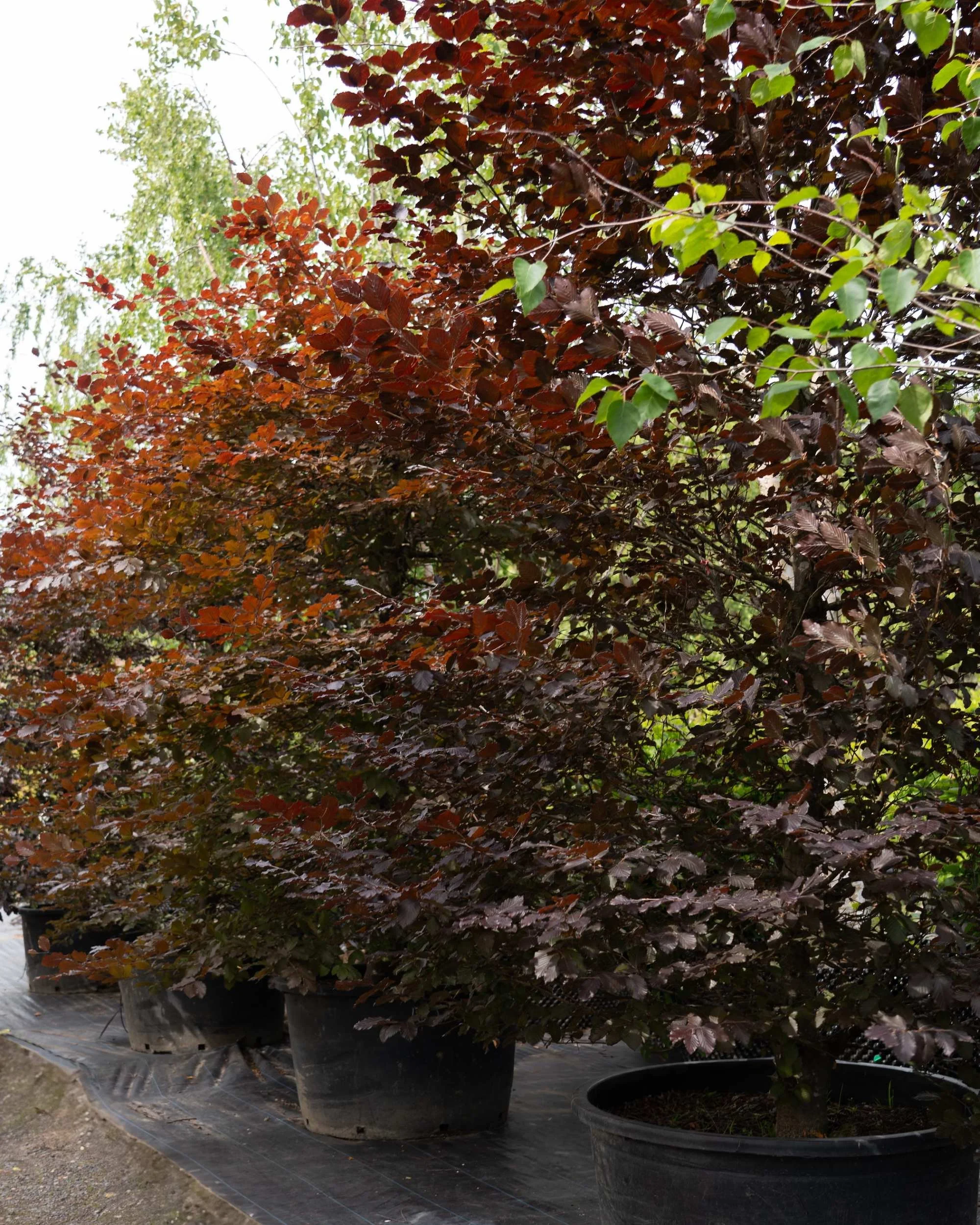
Standard Trees
Fagus sylvatica 'Atropunicea'
Copper beech
Rich purple leaves from spring to autumn and smooth grey bark. The copper beech is one of the most magnificent specimen trees for larger gardens.
Deep purple-copper foliage
Smooth grey bark
Majestic, long-lived specimen
Striking contrast with green trees
Please check before you visit. Our nursery is very well stocked, but what we hold changes with the seasons, so this plant may not always be in stock. Enquire before you head over and we will check availability and the sizes we have for you.
At a glance
Type
Standard tree
Foliage
Deciduous
Seasons of interest
Spring to autumn foliage
Eventual size
Large in time; 15 m or more
Position
Full sun
Soil
Free-draining, including chalk
Hardiness
Fully hardy in the UK
Available
A range of girth sizes, root-balled in season or container-grown. Ask our team for current specimens and pricing.
Why we love it
A copper beech in full leaf is one of the most dramatic sights in any garden. The new leaves open in spring a translucent ruby red, so that with sunlight behind them the whole tree glows like stained glass. As they mature they darken to a rich, deep purple that holds through summer, then shift to coppery bronze and warm russet in autumn. The smooth grey trunk gives a cool contrast to all that colour.
Fagus sylvatica 'Atropunicea' has the same noble, broad-domed shape as green beech, with a canopy that reads as a solid mass of dark colour from a distance. It has been planted in English country houses and parks for generations, and it brings that same sense of grandeur and permanence to a garden today.
Choosing a size
As with other standard trees, copper beech is graded by the girth of the trunk a metre above ground, the height of its clear stem and the overall height. A smaller girth tree is lighter to plant and quick to establish, while a mature specimen gives the full impact of that purple canopy from the very first spring. Leaf colour and crown shape vary a little from tree to tree, so it is well worth visiting to pick the one that suits your setting.
How to use it
Copper beech needs space, so it is at its best as a single specimen in a large lawn or park-like garden, framed by plenty of green. Its dark foliage makes a superb backdrop for pale flowers and silver foliage, and it looks wonderful set against a sky or beside a pale stone building. On a big estate, it can be paired with green beech for a striking contrast across a view.
Planting
Plant root-balled trees between November and March, or pot-grown trees at any time as long as you keep them watered. Dig a wide hole, no deeper than the root ball, and set the tree so the top of the root ball sits level with the soil surface. Stake or guy it firmly, water generously and spread a thick layer of peat-free mulch around the base, leaving a gap around the trunk.
Looking after it
Water deeply every week through dry spells for the first two summers. Very little pruning is needed: remove dead or crossing branches in late summer or winter, and raise the crown gradually as the tree grows if you want to walk beneath it. Copper beech loves free-draining soil, including chalk, and needs full sun to keep its richest colour. Avoid compacting the soil over its shallow roots.
Is copper beech the same as purple beech?
The two names are used almost interchangeably for the purple-leaved forms of Fagus sylvatica. Seed-raised purple beech varies in colour from tree to tree, whereas a named selection such as 'Atropunicea' is grown to give a reliably rich, deep purple canopy. Both have the same habit and needs as green beech.
See it in person
Every plant at Form is hand-selected, none contains new peat, and nothing beats choosing yours by eye. Visit our Row Town showroom in Surrey, just 30 minutes from London, where our team will show you the best of what is on the nursery right now. We deliver across London, Surrey and the Home Counties, and nationwide.
Walk in any time during opening hours and you will be looked after. If you would like dedicated time with a specialist, book a Genus Bar appointment.

Frequently asked questions
-
Copper beech is a large tree, reaching 15m or more and eventually 20 to 25m with a similar spread in ideal conditions. It grows steadily rather than quickly, so it takes many years to reach full size.
-
It is best suited to large gardens where it can develop its full crown. For smaller spaces, purple beech grown as topiary or hedging gives the same colour in a more compact form.
-
It is natural for copper beech leaves to lose a little intensity and turn bronze or slightly green in late summer, especially in shade or on the inside of the canopy. Full sun keeps the colour at its deepest.
-
The leaves open in late April to early May, starting a bright ruby red before deepening to purple over the following weeks.
-
Yes, it thrives on free-draining chalky and limestone soils, just like green beech. It is less happy on heavy, waterlogged clay.
-
Give it plenty of room, well away from buildings, drains and boundaries, as its roots and canopy become extensive. As a guide, allow for its eventual spread, which can reach 15m or more.
-
Prune in late summer or in winter while the tree is dormant. Keep pruning light and gradual, removing damaged branches and lifting the crown over several years rather than all at once.
-
Yes. Like green beech it supports many insects and fungi, and its autumn nuts provide food for birds, squirrels and small mammals.
-
We keep a very well-stocked nursery, but our stock changes with the seasons, so availability varies. Please email us before you visit and we will check what we have and the sizes available.
-
Yes, and we encourage it. Visit our Row Town showroom in Surrey, or book a Genus Bar appointment with one of our specialists. We can also send photographs of individual trees.
-
Yes, we deliver nationwide with our own in-house team, and larger trees can be offloaded by HI-AB or Moffett.
All our standard trees
Explore every tree in our standard trees collection, or view them all with photographs →
Can’t see what you’re looking for?
Get in touch and we’ll help you find it. Our nursery is very well stocked and we can source almost any plant through our network of trusted growers. Email info@formplants.com, or send us your whole plant list through our bespoke sourcing service.