
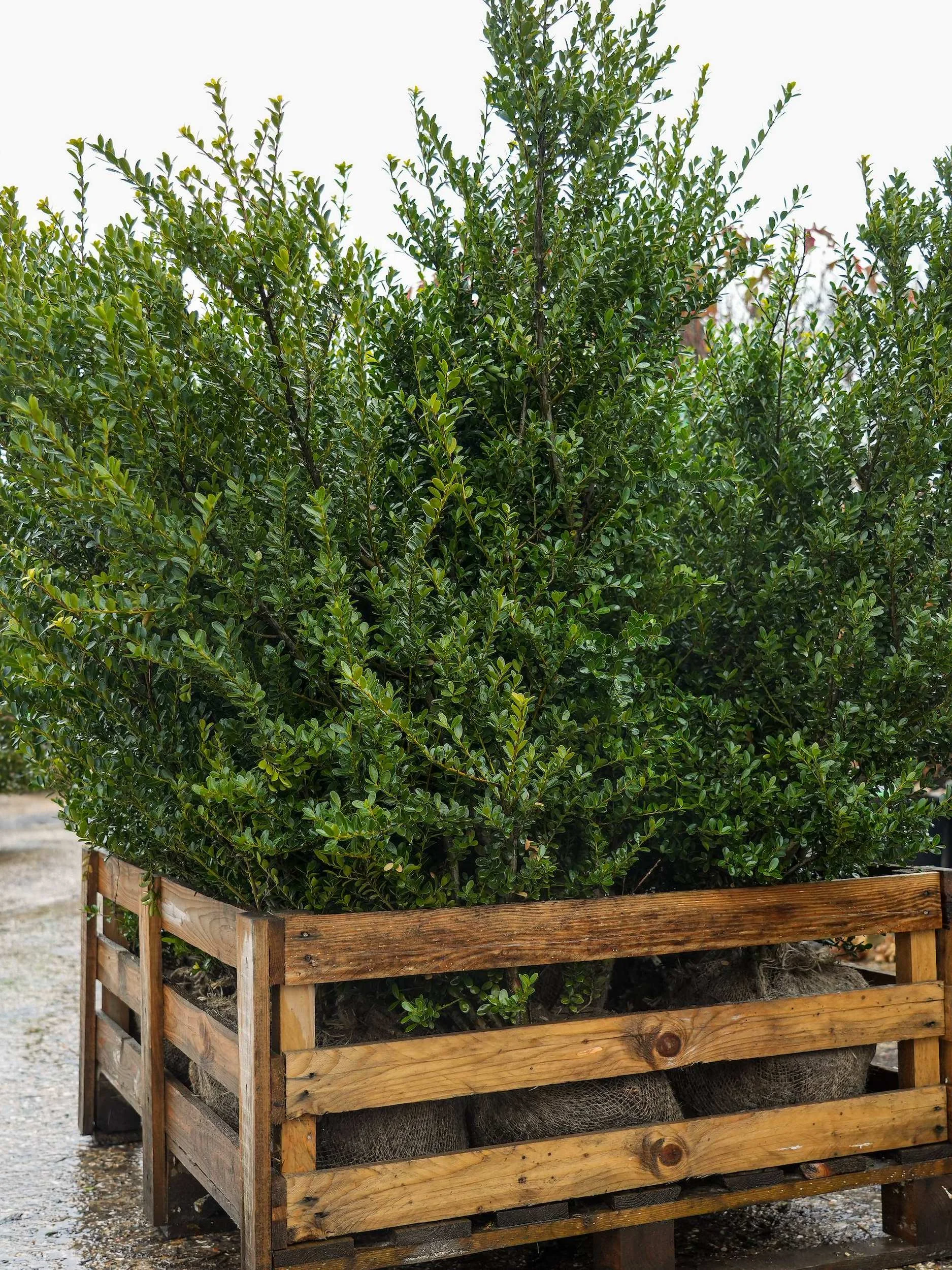
Topiary
Ilex crenata
Japanese holly
Tiny, glossy, dark green leaves that clip as tightly as box, without the blight or the caterpillar. Our first choice for balls, domes and cloud-pruned shapes.
The best evergreen alternative to box
Balls, domes, cubes and cloud-pruned forms
Happy in pots or in the ground
At a glance
Type
Topiary
Foliage
Evergreen
Shapes
Balls, domes, cubes, cloud-pruned (niwaki) forms and bespoke shapes
Growth rate
Slow
Position
Full sun or partial shade
Soil
Moist but well-drained, neutral to acid; dislikes dry chalk
Pots or ground
Both, with regular watering in containers
Hardiness
Fully hardy in the UK
Available
Individually shaped pieces in a range of sizes. Ask our team for current shapes and pricing.
Why we love it
Ilex crenata, the Japanese holly, is one of the finest evergreens for topiary. Its leaves are tiny, glossy and dark green, packed so densely along the stems that clipped shapes look smooth and solid, with a crisp, sculpted finish all year. Unlike common holly, the leaves have no spines, so it is pleasant to handle and to brush past.
Japanese holly has a long tradition in Japanese gardens, where it is clipped into clouds, mounds and tiered forms, and it has become a favourite in Britain as an alternative to box. It grows slowly, holds its shape for months between clips, and brings a calm, refined, evergreen structure to both formal and contemporary designs.
Choosing a size
Ilex crenata topiary comes as balls, domes, cubes and low blocks, along with more sculptural forms such as cloud-pruned pieces and standards. Smaller balls suit pots, window boxes and edging, while larger domes and cloud shapes make striking focal points in their own right. Cloud-pruned pieces in particular are all unique, so we always encourage you to come and choose yours by eye at the nursery.
How to use it
Use Japanese holly balls to edge paths and borders, repeat them through planting for rhythm, or group different sizes together for a relaxed, rolling effect. Cloud-pruned pieces make wonderful focal points in Japanese-inspired and contemporary gardens, and all shapes look elegant in containers on a terrace or by a front door. It also forms neat, low hedges, and it is a natural choice for replacing box in an existing parterre or knot garden.
Planting
Pot-grown topiary can be planted at any time of year with careful watering, though autumn and spring are ideal. Dig a hole wider than the root ball but no deeper, ideally improving the soil with peat-free, ericaceous or leafy compost on neutral ground. Firm gently, water thoroughly and mulch with peat-free compost to keep the roots cool and moist.
Looking after it
Keep well watered for the first two summers and never let it dry out, especially in pots. Clip in early summer once the new growth has firmed, with a second light trim in late summer if needed for very crisp shapes. It prefers moist but well-drained, neutral to acid soil in sun or partial shade, and dislikes dry chalk, where the leaves can yellow. Use sharp shears for a clean cut, and a feed with an ericaceous fertiliser in spring keeps the foliage a rich, glossy green.
Is Ilex crenata a good alternative to box?
Yes, it is one of the best. Its small, glossy evergreen leaves clip to a similar dense finish, and it is not affected by box blight or box tree caterpillar. It does prefer moister, more acidic soil than box, so it suits gardens with neutral to acid ground, or containers filled with suitable compost.
See it in person
Every plant at Form is hand-selected, none contains new peat, and nothing beats choosing yours by eye. Visit our Row Town showroom in Surrey, just 30 minutes from London, where our team will show you the best of what is on the nursery right now. We deliver across London, Surrey and the Home Counties, and nationwide.
Walk in any time during opening hours and you will be looked after. If you would like dedicated time with a specialist, book a Genus Bar appointment.

Frequently asked questions
-
Yes, it keeps its small, glossy dark green leaves all year round.
-
It grows slowly, which makes it easy to keep in shape and means clipped forms hold their outline for a long time.
-
Clip in early summer once the new growth has firmed. A second light trim in late summer keeps formal shapes extra crisp.
-
No, unlike common holly its small leaves are smooth-edged and spineless.
-
Yes, it grows very well in containers of peat-free compost with some ericaceous compost mixed in. Water regularly, as pots must not dry out.
-
Yellowing is usually caused by alkaline soil, dry roots or waterlogging. It prefers neutral to acid, moist but well-drained soil, and an ericaceous feed can help on less acidic ground.
-
Yes, it grows in full sun or partial shade, keeping a dense habit in both.
-
Like other hollies, its berries can cause stomach upset if eaten, so it is sensible to discourage children and pets from eating them. Clipped plants produce few berries.
-
We keep a very well-stocked nursery, but our stock changes with the seasons, so availability varies. Please email us before you visit and we will check what we have and the sizes available.
-
Yes, and we recommend it. Every piece of topiary is hand-shaped, so no two are quite the same. Visit our Row Town showroom in Surrey to choose your pieces by eye. Walk in any time during opening hours, or book a Genus Bar appointment with one of our specialists.
-
Yes, we deliver nationwide. Deliveries are arranged by our dedicated in-house operations team, and larger pieces can be offloaded by HI-AB or Moffett where needed.
All our topiary
Explore every option in our topiary collection, or view them all with photographs →
Ilex crenata
Can’t see what you’re looking for?
Get in touch and we’ll help you find it. Our nursery is very well stocked and we can source almost any plant through our network of trusted growers. Email info@formplants.com, or send us your whole plant list through our bespoke sourcing service.